Health and Safety

Without care and attention to employee health and safety, SHN would not exist.

Employee health and safety is critical to SHN’s sustainability, values, and mission; without care and attention to employee health and safety, SHN would not exist.  Because employees are frequently working in construction and industrial settings, injury hazards are high but we mitigate them through our safety efforts.  In-office health and safety is also an important aspect of SHN’s program; risks include repetitive injuries, lifting injuries, and sedentary conditions.  These issues are also included in OSHA regulations.

Safety is embedded in our culture.  We encourage the reporting of incidents and do not retaliate against employees injured on the job. Learn from our experiences. SHN is proud of our EMR rating which is below 0.90 since 2021.

Highlights of SHN’s health and safety program include:

  • Leadership at the top.  The Principal of Environmental Services is our company’s Health and Safety Officer.  He sets the tone for SHN’s safety culture by communicating its importance and how every employee must be aware of and involved in the safety program.
  • Communication and documentation.  The safety program’s primary elements are regular in-office safety meetings, general safety training, a hazard communications program, on-site general and daily safety meetings, project-specific site safety plans, and an emergency action plan.  The safety committee meets once per quarter to review the program and its results, and to implement any improvements. 
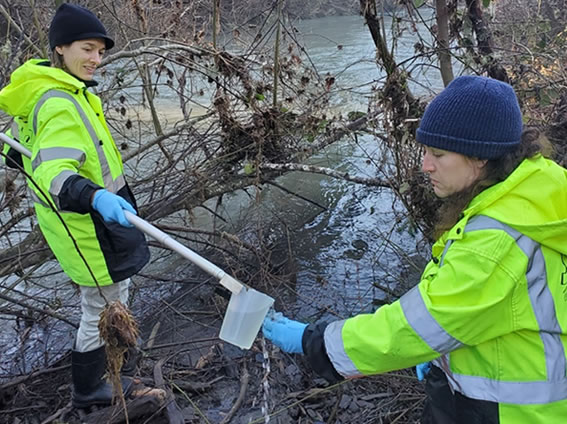
  • Personal Protective Equipment (PPE).  SHN provides PPE, which includes hard hats, respirators, safety vests, face shields, safety glasses (including prescription eye glasses if needed), goggles, hearing protection, gloves, steel-toed boots where warranted, and full Tyvek suits.  A project’s site safety plan specifies what level of protection is necessary, and employee compliance is mandatory; willful disregard is sufficient for termination. 
  • Properly fitting raingear.  Finding a high-quality source was not easy, but we procured women’s raingear so that poorly fitting PPE is not the source of an injury!
  • Encouragement of employee wellness.  Employees accrue paid time off and are encouraged to use it.  We provide a sick leave “bucket” that is greater than mandated, and there is no year-over-year cap. Employees have confidential access to counseling through a robust employee assistance program.
  • Compliance with state and federal laws and regulations.  The Occupational Safety and Health Administration (OSHA) is the federal agency that issues regulations for worker safety, but California and Oregon have OSHA-Approved State Plans (OSHA, 2014).  OSHA regulation coverage is extensive; examples of coverage are regulations for trench shoring, “Workers’ Right to Know” about hazardous chemicals in the workplace, and protection against retaliation should an employee report violations (“Whistleblower Protection”).
  • Hazard Communication Program.  Workplace hazards are communicated via the above safety program channels, but specific to chemical hazards, SHN provides information and instruction on proper container labeling, how to read Safety Data Sheets, training on the use of PPE, and training on what to do in case of exposure. 

We specialize in civil, environmental, and geotechnical engineering; geosciences; planning and permitting; surveying and drones; environmental and biological sciences; and materials testing and special inspections.